Procurement · Pilot · 508 / modernization
Governance-Aware Accessibility Operations Platform powered by UAOR
ICT acquisition lifecycle governance — operational oversight across acquisition review, remediation, and post-award validation. Not one-time scans.
Use case — relate first
Federal accessibility remediation operations
A federal contractor manages multiple public-facing web applications that must maintain Section 508 and WCAG compliance throughout acquisition, remediation, and the operational lifecycle.
Engineering already uses GitHub, CI/CD, accessibility scanners, manual audits, and PDF/CSV reporting. The challenge is not finding issues — it is governing remediation consistently while preserving defensible evidence for procurement, audits, and modernization reviews.
Before SD Panthers
Scattered workflow, weak governance
scanner → spreadsheet → email → ticket → manual follow-up
- Findings scattered across tools; stale tickets; inconsistent ownership
- Weak audit traceability; limited operational visibility; no unified remediation posture
- Exports disconnected from engineering state
Leadership cannot easily answer:
- Which projects are degrading? Beyond SLA? Integrations failing?
- Which issues drifted from GitHub/Jira? What evidence supports remediation claims?
With SD Panthers
Governed operational flow
CI accessibility scan → governed ingest → operational lifecycle → GitHub/Jira sync → human review → exportable evidence → operational intelligence dashboard
Accessibility becomes an operational governance function — not merely a scanning exercise. Same datastore powers dashboards, workflows, integrations, telemetry, and procurement exports.
Example workflow (1–3)
Ingest, lifecycle, engineering sync
- Scan ingest. CI runs validation on deploy; findings ingest via webhook/API with severity, timestamps, workflow state, integration status, audit events.
- Governed lifecycle. New → Triaged → In Progress → Pending Review → Approved → Resolved. Each transition: immutable audit events, telemetry, exportable evidence.
- GitHub / Jira sync. Link findings to trackers; monitor sync freshness, retry failures, stale integrations, dead-letter queue — shared operational posture with engineering.
Example workflow (4–6)
Review, intelligence, evidence
- Human review + governance. Remediation requires review; policy gates enforce discipline; approval/rejection recorded — no silent autonomous closure.
- Operational intelligence. SLA breaches, degraded integrations, retry pressure, stale sync, remediation velocity, scorecards, export-ready summaries.
- Exportable evidence. CSV, PDF, JSON snapshots from the same store as live KPIs — defensible packages for procurement and audit.
Result
Operational outcomes
| Capability | Outcome |
|---|---|
| Governed remediation workflows | Accountability |
| GitHub/Jira synchronization | Engineering alignment |
| Human review gates | Controlled remediation |
| Operational telemetry | Visibility into degradation and failures |
| Exportable evidence | Procurement and audit readiness |
| AI-assisted guidance | Faster remediation workflows |
SD Panthers AI Accessibility Operations transforms accessibility from isolated scanning into a governed operational workflow with telemetry, integrations, auditability, human review, and exportable evidence.
Live demo bridge
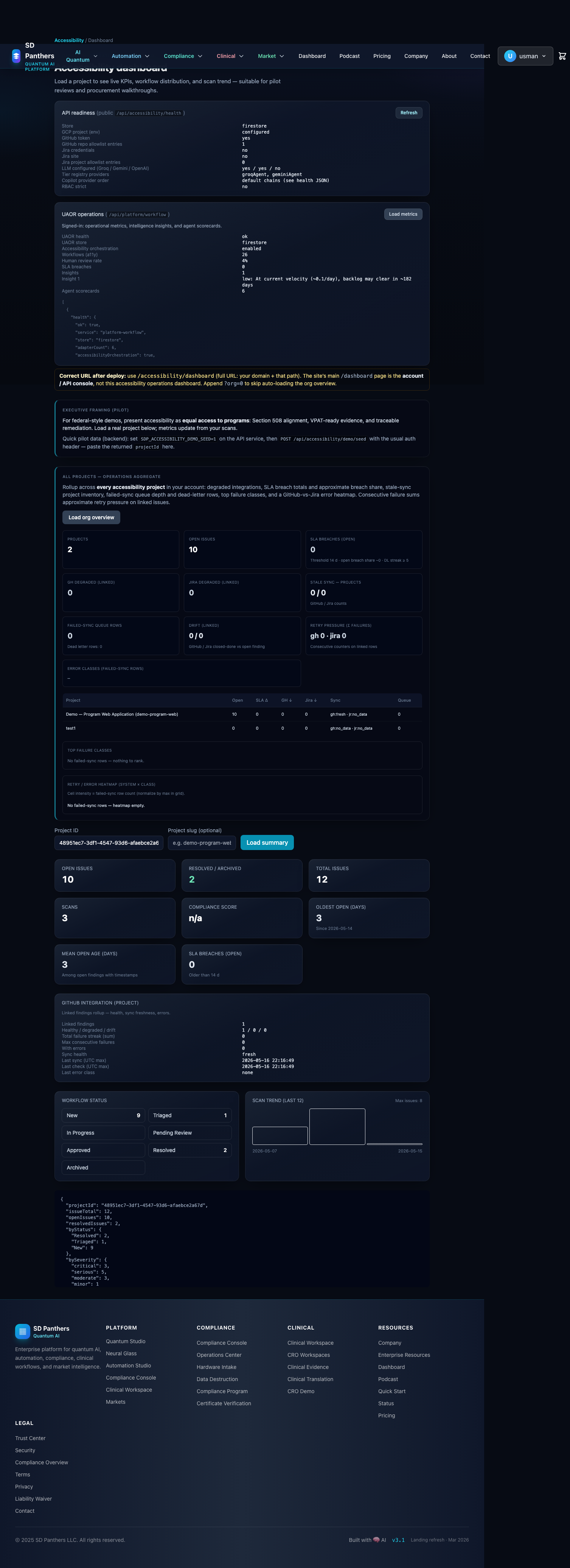
See it on project demo-program-web
Plan / ingest (axe / CI) → Remediate (workflow + review + UAOR) → Integrate (GitHub #4) → Validate (CSV / PDF exports).
- We do not replace your scanner or issue VPATs — we operationalize findings after ingest.
- 12 pre-ingested findings — demo shows remediation and governance after the scan.
Pilot demo: /accessibility/demo
Platform — Problem
Accessibility programs fail in the operational gap
- Scans produce findings; programs need persistent posture, accountable remediation, defensible evidence.
- Federal buyers need traceability: who changed what, when, with exportable proof.
- Tool sprawl breaks governance and slows modernization.
Platform — Capabilities
Operationalize accessibility as a governed program
- Visibility: live KPIs, SLA posture, scan trend, org-wide rollup.
- Orchestration: UAOR workflows with human review gates.
- Explainability, evidence exports, GitHub + CI ingest.
UAOR
Unified Adaptive Operational Runtime — governed operational AI
- Every issue maps to a workflow instance with immutable event ledger.
- Policy + human review before irreversible actions.
- Agent mesh assists under orchestration — not free-running automation.
Lifecycle
Findings move through a controlled, auditable lifecycle
- New → Triaged → In Progress → Pending Review → Approved → Resolved.
- Each transition emits UAOR events (workflow, task, explain, learning).
- Same records in UI, API, and exports.
Governance
AI assists; humans govern
- Copilot: issue-scoped remediation narrative (WCAG / 508 context).
- Review gates before closure — no silent autonomous resolution.
- Audit log answers what happened and why.
Integrations
GitHub sync and procurement-ready exports
- Finding linked to GitHub issue #4 → synced state in dashboard and exports.
- CSV, PDF, JSON snapshot from the same operational store as live KPIs.
- Failed-sync queue, dead-letter, and retry pressure visible in org overview.
Operational intelligence
Leadership sees operational AI posture, not vanity scan counts
- 12 issues / 3 scans — 2 resolved, 10 open (real backlog).
- Remediation velocity, SLA, agent scorecards with non-zero runs.
- Export reads as operational governance report.
Close — Federal acquisition lifecycle
Lifecycle governance, not a one-time scan
- Plan → acquire → remediate → validate — continuous operational oversight.
- Procurement traceability: exports, audit ledger, VPAT/ACR review workflows (we do not issue VPATs).
- Pilot-ready: frozen evidence + deterministic 5-minute walkthrough.
Live demo: /accessibility/demo